

Our Vision
A Future, Reimagined.
Driven by a commitment to institutional responsibility, Sagga & Co. exists to design the systems Canada needs for long-term renewal, connecting policy, technology, and lived experience into a functional, dignified future.
Canada is not broken, but many of its systems are outdated.
Housing no longer provides security. Healthcare struggles to meet demand. Food systems are vulnerable. Work is being reshaped by automation. Democratic trust is eroding. These are systemic challenges that demand systemic thinking.
Sagga & Co. approaches these challenges with patience, rigour, and institutional responsibility. Our work is grounded in research, lived experience, and a belief that societies improve when governance evolves alongside technology and human need.
Hover a system to trace how it connects to the others.
Housing
Housing is the foundation everything else is built on. A household without secure shelter cannot hold a job reliably, keep a child in one school, or manage a chronic condition, which means housing failure arrives at every other public service with the bill attached.
A home should not trade like a security. It is where a family sleeps, a child does homework, and a parent recovers. Pricing it as an appreciating asset class puts the person who needs shelter most into a bidding war against an investor who needs none. Housing is a basic human right, not a commodity for a landlord, a fund or a corporation to corner, inflate or take over. That means building it to be genuinely affordable, sustainable enough to keep its running costs low, and smart enough in how it's built that upkeep never becomes a second mortgage.
The lending system wrapped around it compounds the problem it claims to solve. A bank lends against a structure that starts depreciating the day it's finished, on land whose price it does not control, and collects decades of compounding interest on the gap, while the buyer alone carries the risk of every rate cycle in between. A household priced out of that arrangement is not failing at personal finance; it has run into a system built to extract value from shelter rather than provide it. Fixing housing means severing the link between a roof and speculation, not managing the speculation more gently.
Canada's shortfall is not only a question of demand. It is a supply system that takes the better part of a year to produce a single home, prices land as an asset rather than a place to live, and treats zoning as settled law. We work on the three levers that actually move: how fast a home can be built, who is permitted to build one, and on whose land.
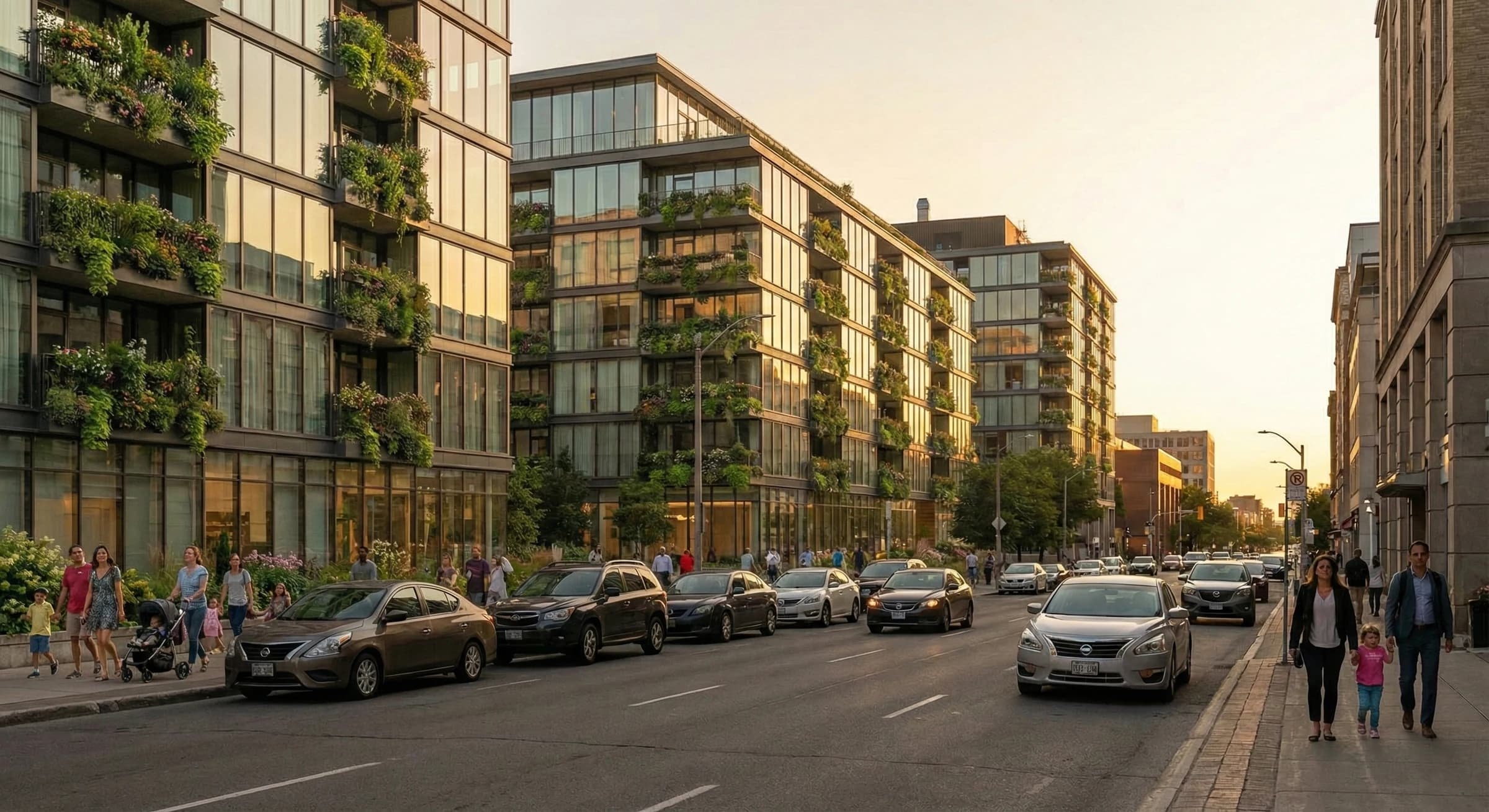
Institutional Conversion: Downtown office stock built for a working pattern that no longer exists sits half-empty on serviced land, already connected to transit, water and power. Converting it produces housing without consuming a hectare of new land, and returns residents to districts that currently empty out at six in the evening.
Local Prosperity: Roughly half the work on any build stays on site: foundations, craneage, service connections, finishing. Those are local contracts held by local framers, plumbers and electricians. A housing programme delivered this way is simultaneously an employment programme for the community hosting it.
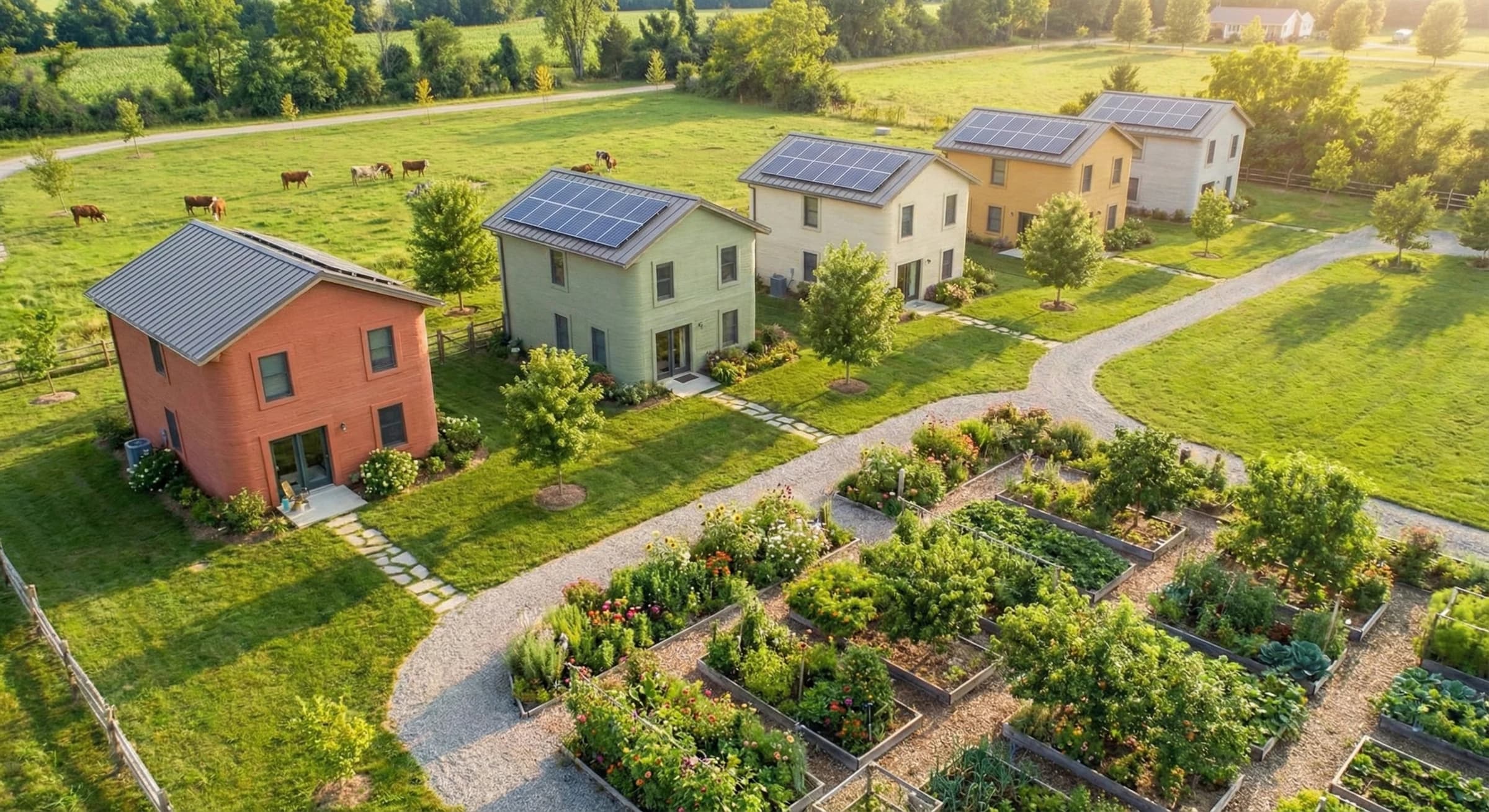
The Modern Homestead: Long-term leases on public land, paired with modular and 3D-printed construction, let a household enter housing without a deposit wall, and hold enough ground to grow on. Printing a home's structural walls in a single day, layer by layer in concrete, cuts construction waste by roughly sixty per cent and produces a shell more resistant to fire, mould and extreme weather than a conventional stick-built frame: sustainable and fast because of how it's built, not as an add-on feature. The obstacles are tenure rules and mortgage eligibility, not technology.
Interactive
How a modular home goes up
Step the build · drag to look around
The array is commissioned, the landscaping is in and the house is occupied. A conventional build started on the same day, on the adjacent lot, would still be several months from a certificate of occupancy.
The time saving does not come from working people harder. It comes from doing two things at once: the foundation is prepared on site while the volumes are manufactured indoors. Canadian analysis of modern methods of construction finds this parallel approach can deliver a comparable home up to fifty per cent faster.
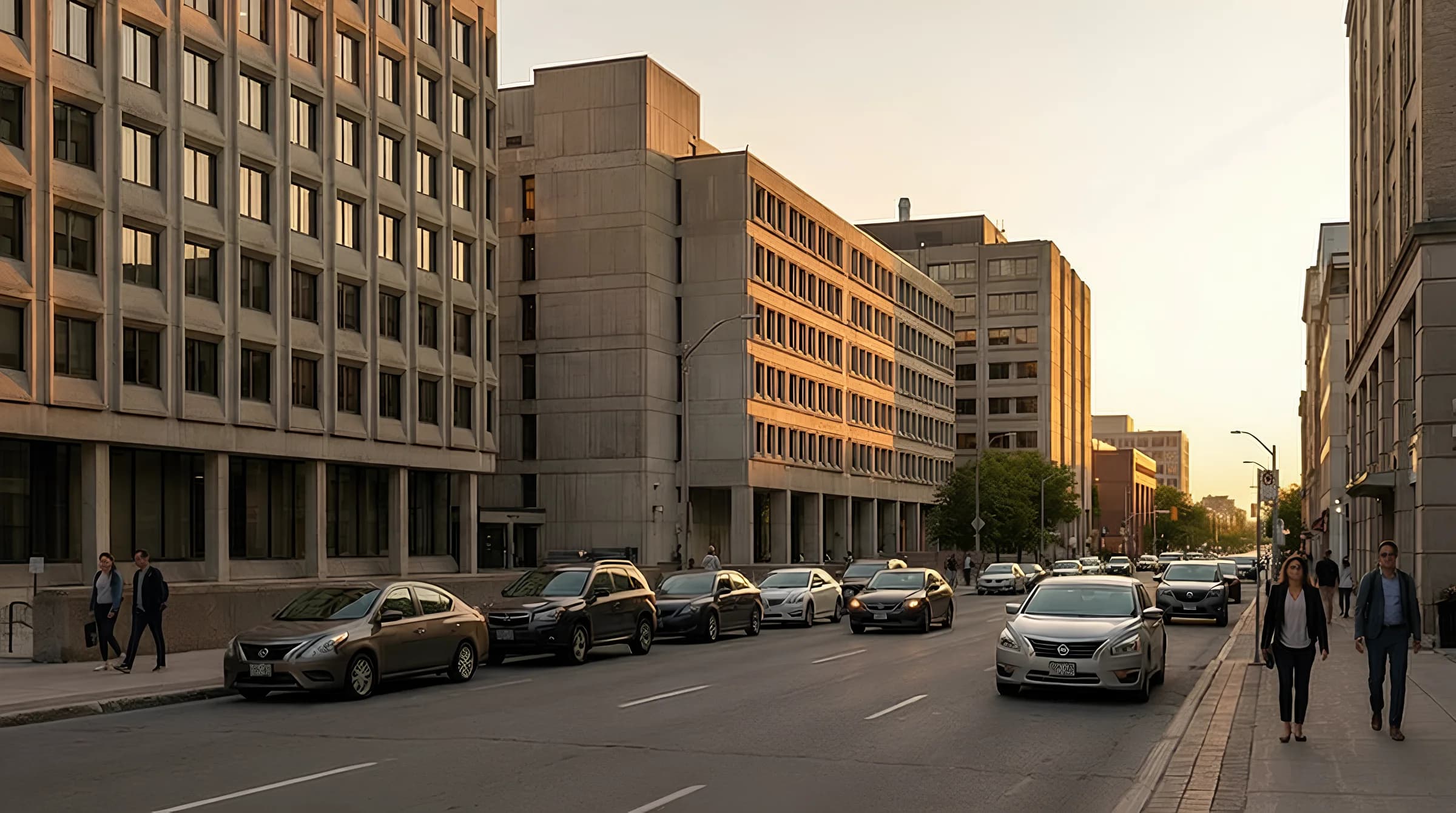
Drag to compare. Illustrative visualisation of a conversion on a typical Ottawa government block.
Institutional conversion
The fastest homes to build are the ones already standing
Downtown office stock built for a working pattern that no longer exists sits half-occupied on serviced land, already connected to transit, water and power. Converting it produces housing without consuming a single new hectare, and returns residents to districts that currently empty out at six in the evening.
The obstacles are technical and legal rather than physical: floor plate depth, glazing, mechanical risers, and a zoning designation written for a different decade. Those are solvable with a building code pathway and a municipal decision, which is precisely the kind of work this institution exists to do.
Healthcare
Canada's healthcare crisis is as much logistical as it is medical. The country has skilled clinicians and a funded system; what it lacks is anywhere to be seen between a family doctor with no openings and an emergency department with a six-hour wait.
So everything defaults to the most expensive door in the building. We work on decentralised care: small permanent clinics at neighbourhood scale, open around the clock, equipped to resolve most of what currently queues behind a genuine emergency, and paired with automated medication dispensing so treatment doesn't stall at the pharmacy counter. Not a replacement for hospitals. A way of letting them do the thing only they can.
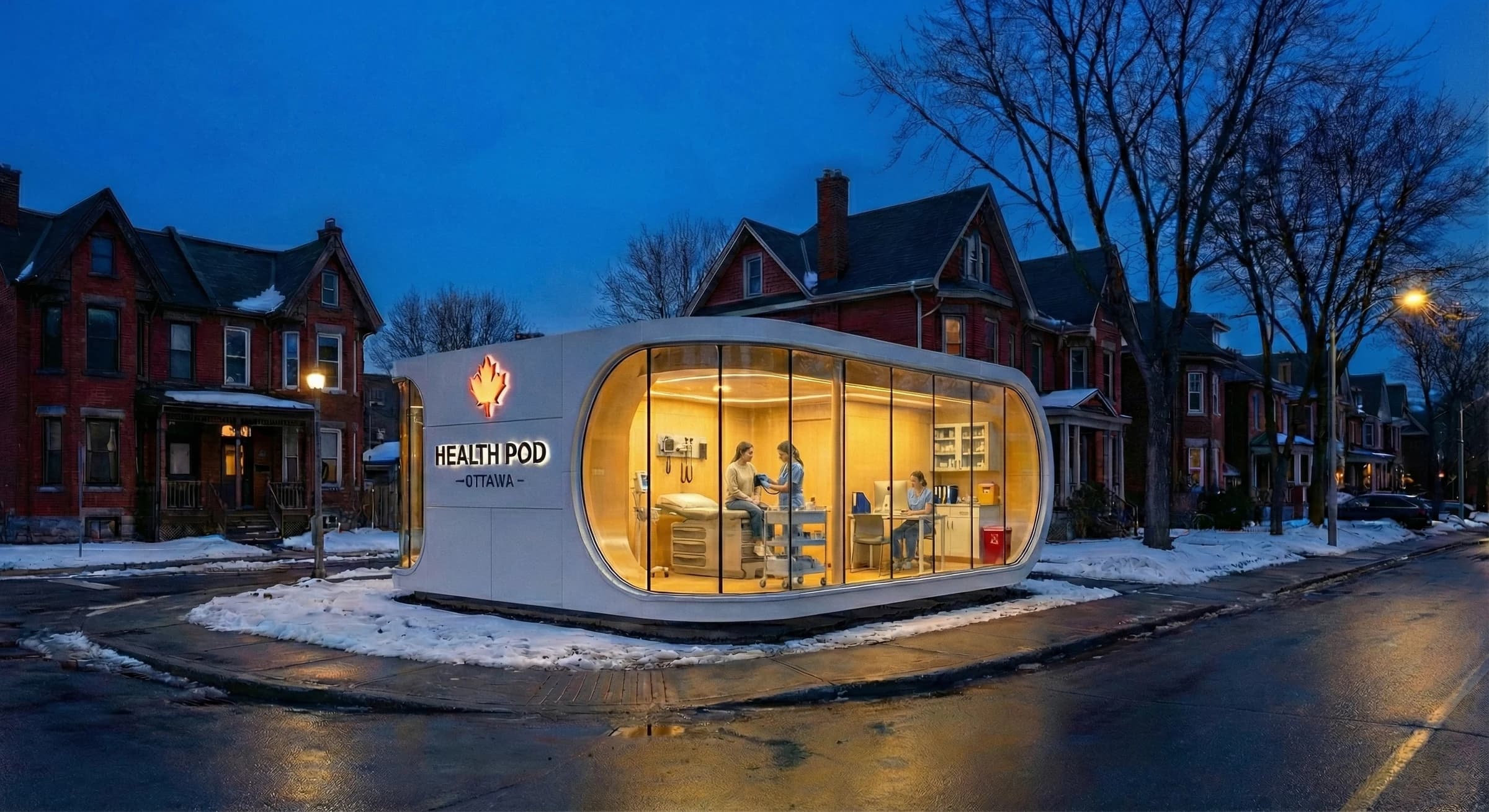
The Neighbourhood Pod: A small permanent clinic on an ordinary residential corner, roughly the footprint of a corner shop, open around the clock. Research consistently finds one variable behind avoidable emergency attendance: whether a patient could be seen somewhere else the same day.
Everything in one visit: Nurse-led care with physician escalation, point-of-care diagnostics read on site, and a 24-hour automated dispensing kiosk built into the wall. A prescription that requires a separate trip to a pharmacy is one a shift worker, a parent without transport, or a patient in pain may never fill, so the assessment, the test and the medication happen in the same visit, and the kiosk keeps dispensing against a health card long after the clinic has closed for the night.
System Relief: Every condition resolved at neighbourhood level is one that never queues behind a genuine emergency. The point is not to replace the hospital. It is to let the hospital do the thing only a hospital can.
Interactive
Inside a neighbourhood health pod
Isolate a zone · drag to look around
One building, four functions
A permanent building on an ordinary residential corner, occupying roughly the footprint of a corner shop. It contains four functions: a reception and waiting area, a single treatment bay, point-of-care diagnostics, and a small dispensary. It is staffed by nurse practitioners with physician escalation available, and it does not close. Set into the end wall is a 24-hour dispenser that issues prescribed medication against a health card even when the pod itself is unstaffed. A roof array and battery keep lighting, refrigeration and records running through a power interruption.

Food Security
Reliable access to food is a national security question Canada has been fortunate enough to treat as a grocery question. A head of lettuce on an Ontario shelf in February has usually crossed a continent and a border, through a chain any one of whose links can fail on a week's notice.
The shorter that chain, the less exposed the household at the end of it. We research urban agriculture, controlled-environment growing, local production incentives, and the tax treatment of basic staples, because the distance between food being expensive and food being unreachable is often a few percentage points at the till.
That fragility is made worse by who controls the last few feet of the chain. A small number of grocery chains set the shelf price nationwide, and in the same years households have cut groceries to make rent, those chains have posted record profits and paid their executives accordingly. Food is not a category where a handful of shareholders should get to decide what a family can afford to eat. It is among the most basic entitlements a person has, and government's role is to see that the price at the till reflects what it costs to grow, not what a concentrated market can be made to bear.
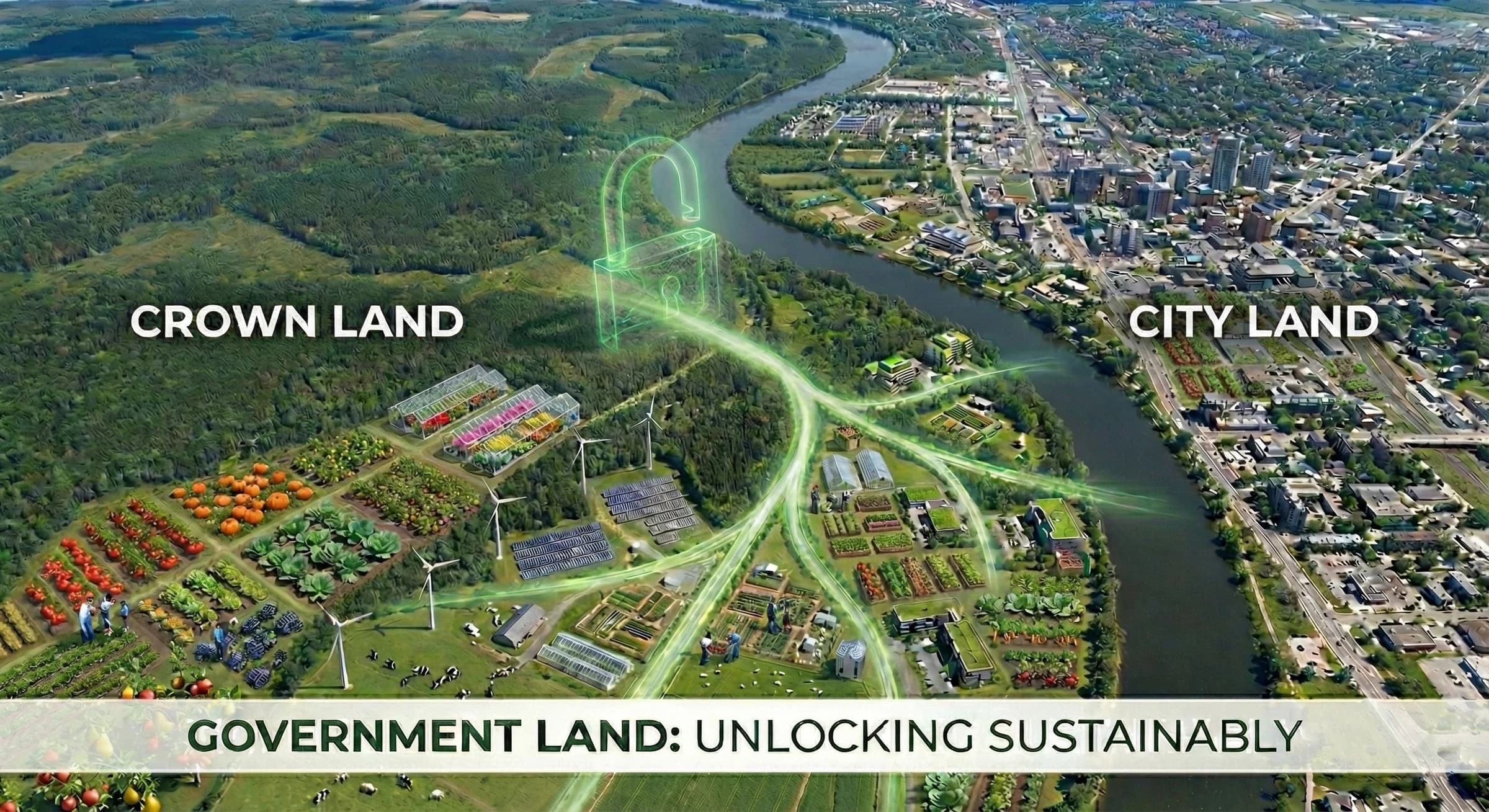
Opening the Land: Underused municipal and provincial parcels sit inside every Canadian city. Opening them to growers costs the state an administrative decision rather than an acquisition budget, and produce that travels a few blocks needs none of the packaging, refrigeration and margin that produce crossing a border does.
The Basic Staple Right: Zero tax on grain, vegetables, fruit, eggs, milk and butter, with production incentives on the supply side. The distance between food being expensive and food being unreachable is often a few percentage points at the till.
Community Distribution: Markets at the edge of the plot that grew the produce, and outreach boxes carrying the basics to households that need them. Sold where it was grown, roughly three-quarters of the shelf price reaches the grower, against about a sixth under an imported chain.
Interactive
A working market garden on city land
Isolate a system · drag to look around
One parcel, five systems
A working market garden on land a municipality already holds. Five systems operate together: open beds for the storable bulk crops, vertical towers for high-turnover salad and herbs, a greenhouse to extend the season at both ends, on-site generation and water capture to cover the running costs, and a stall so the produce is sold at the edge of the plot that grew it.
1 ha
feeds roughly 40 households a season
3 km
from plot to plate
Roughly 480 households fed for a season, from land the city already owns, at the cost of a decision rather than a purchase.

Work, AI & Purpose
Automation is not coming for labour in general. It is coming for tasks, and it is moving through them fast. It started with transcription, scheduling and first-pass paperwork. It has already reached customer service, junior analysis, first drafts and first-round screening: the entry-level jobs a generation of Canadians was told were the safe way in. It is not finished: the range of tasks a model can do competently widens every year, which means the floor keeps rising under jobs that used to be considered stable, not just the ones already gone.
What doesn't automate is the part no model can do: turning up in person, being known by name, holding a hard conversation, noticing that something is wrong before anyone says so. Communities are short of exactly that labour and cannot currently afford to staff it. Our work is managing the transition between the two: retraining toward the work that is growing, and building the public spaces where it actually happens.
Getting Ahead of It: The jobs disappearing fastest are the ones with the clearest procedure, which is exactly what made them easy to hire for and easy to train for in the first place. Waiting for displacement to happen before building the next pathway wastes the years when the transition is still manageable. We map which local roles are exposed and which under-staffed services could absorb that labour, and build the retraining bridge ahead of the layoff notice, not after it.
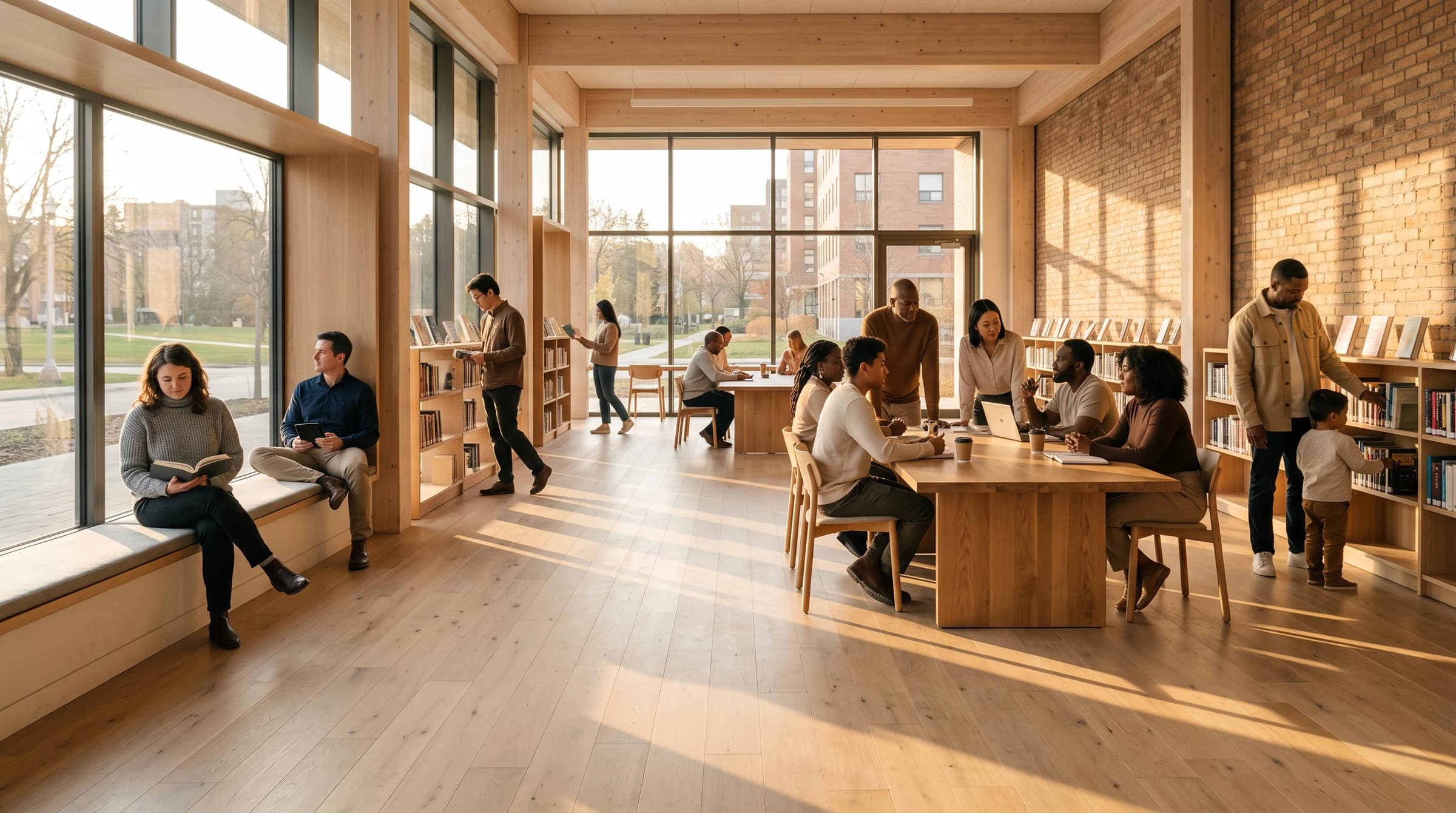
Civic Outreach: The capabilities that outlast automation are the ones outreach work already runs on: reading a situation quickly, explaining a decision plainly, sitting with someone through a hard conversation. Every community has more of this work than it can staff: home visits, benefits navigation, elder check-ins. A displaced worker with the right training is a natural fit for it, not a burden on it.
Ending Loneliness: Prolonged isolation carries a measurable mortality risk and eventually arrives at the health system with a bill attached. An hour of company is cheaper than the admission it prevents, and it is work that requires a person to actually be there: the one category of labour automation cannot touch by definition.
Interactive
Build a park that pays for itself
Add and remove · drag to look around
Free at the point of use and supervised by a paid attendant. It generates no revenue directly, and it is nonetheless the element the site depends on: it is the largest single driver of family attendance, and attendance is what makes every commercial element here viable.
$103,000
earned per season
$37,000
to run it
50,000
visits per season
5
staffed roles
The earning elements cover the free ones. Nobody is charged at the gate, and the park does not return to council every year asking to survive.
The other five months
A park that closes in November is half a park. The court is boarded and flooded into a neighbourhood rink, the bandshell roofs a winter market, the kiosk keeps serving hot food, and the canopy array goes on generating through the coldest, brightest months of the year. The capital is already spent; the question is only whether the site is designed to keep earning after the first frost.
Democratic Renewal
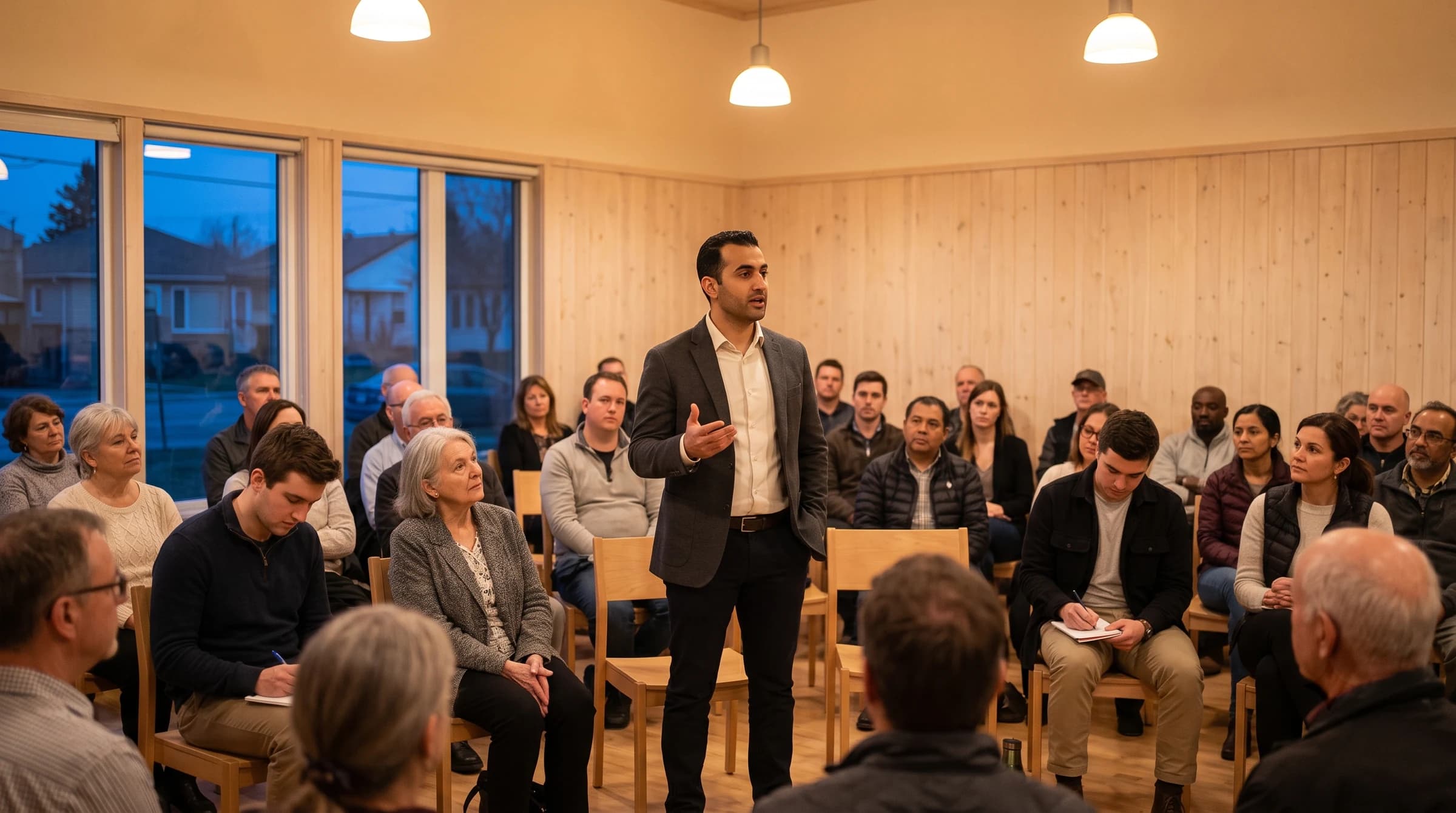
Democratic trust is not eroding because people stopped caring. It erodes when the distance between a vote and its consequence grows so long that the connection stops being visible: one ballot every four years, then four years of decisions nobody outside the room can trace.
Part of that erosion is well earned. Too often the calculation a representative makes behind closed doors weighs a donor's interest, a lobbyist's ask, or a party's fundraising need more heavily than the interest of the constituents who cast the vote. Because that calculation happens in private, a voter has no way to tell a captured decision from an independent one. Opacity is what makes that capture possible; it is the mechanism, not a side effect of politics. Technology does not need to reinvent representation to fix this. It only needs to make the decision-making visible enough that whose interest was actually served becomes a matter of public record instead of a matter of trust.
We study the instruments that close that gap: participatory budgeting, auditable civic technology, and public records a citizen can verify without asking permission from the institution that published them. Representatives keep the mandate. What changes is that the public can check the arithmetic.
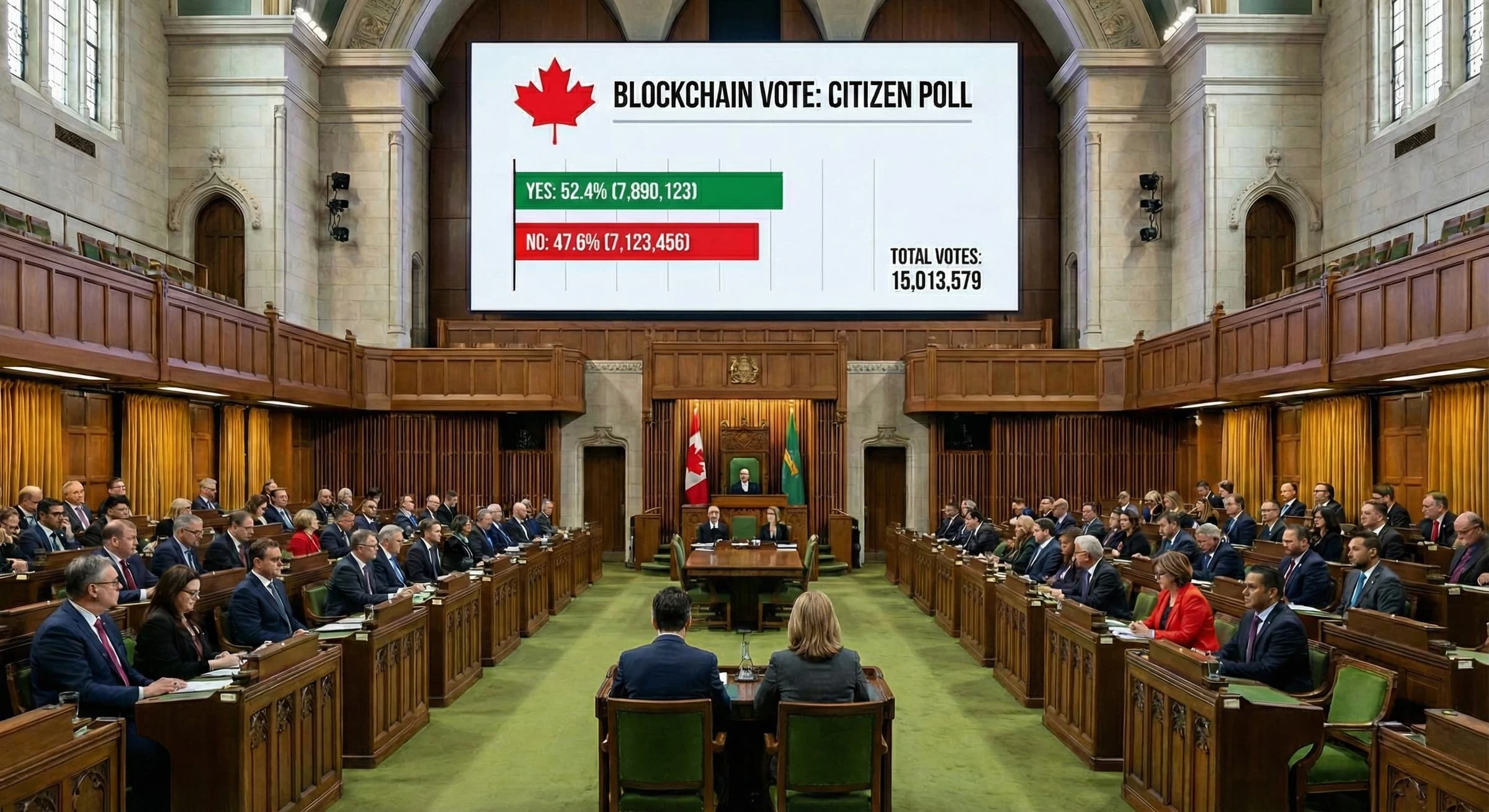
The People’s Vote: A chamber where citizens can register a position on legislation while it is still being debated, alongside their representatives rather than instead of them. Members keep the vote; what changes is that they can see the room they represent.
A record that can be checked: Every vote and budget decision written to a signed public record, so any citizen can recompute the total and confirm it independently. Altering one entry invalidates every entry after it, which makes a quiet amendment impossible rather than merely against the rules.
The Citizen’s Budget: Participatory budgeting applied at municipal scale first, where the sums are legible and the results are visible within a term. A budget the public helped set is a budget the public will read afterwards.
Interactive
A vote you can verify yourself
Cast a ballot · then try to alter the record
Motion before the House
Open unused municipal land to community growers.
- #001YEA7f648348bd…
- #002YEAa2c534a2d7…
- #003NAYb3b1bcd6ce…
- #004YEA84357dd48c…
- #005YEA15f4c3f220…
- #006NAY2fab3e3d2a…
- #007YEA25eb1db9b6…
Each record is signed over the one before it. Anyone can recompute the chain and confirm the total without asking permission from the body publishing it.